By Rev. Stephanie Donaldson
PRAYER FLAGS are used in different parts of the world as a way to pray. Traditionally they are used to promote peace, compassion, strength and wisdom.
Legend has it that prayer flags originated with the Gautama Buddah. Their prayers were originally written on cloth banners to be used against their adversaries. This knowledge made its way into Tibet by 800 CE, with the actual flags being introduced no later than 1040 CE. Tibetans believe that the prayers and mantras will be blown by the wind to spread good will and compassion into all-pervading space, this bringing benefit to all.
Today prayer flags have become a permanent part of life and can be found everywhere, anyone can fly a prayer flag. They are usually hung in high places to bring the blessings found on them to all beings. The belief is that as the wind passes over them the air is purified and sanctified by the mantras.
The most common type of prayer flags are made of colourful rectangular cloth and found strung along trails and peaks in the high Himalayas. Traditionally they come in sets of five, with the different colours representing the five elements. Blue symbolizes the sky and space, white symbolizes the air and wind, red symbolizes fire, green symbolizes water and yellow earth. According to traditional Tibetan medicine, health and harmony are produced through the balance of the five elements. Today, lacking access to the Himalayas, people hang prayer flags in their windows.
Bringing this into the here and now, in addition to my ministry at Holy Trinity Anglican Church, Stratford (formerly St. James), I lead St. Anne’s Worshipping Community in Port Franks in worship one Sunday a month and journey with them. This I do at the request of the bishop.
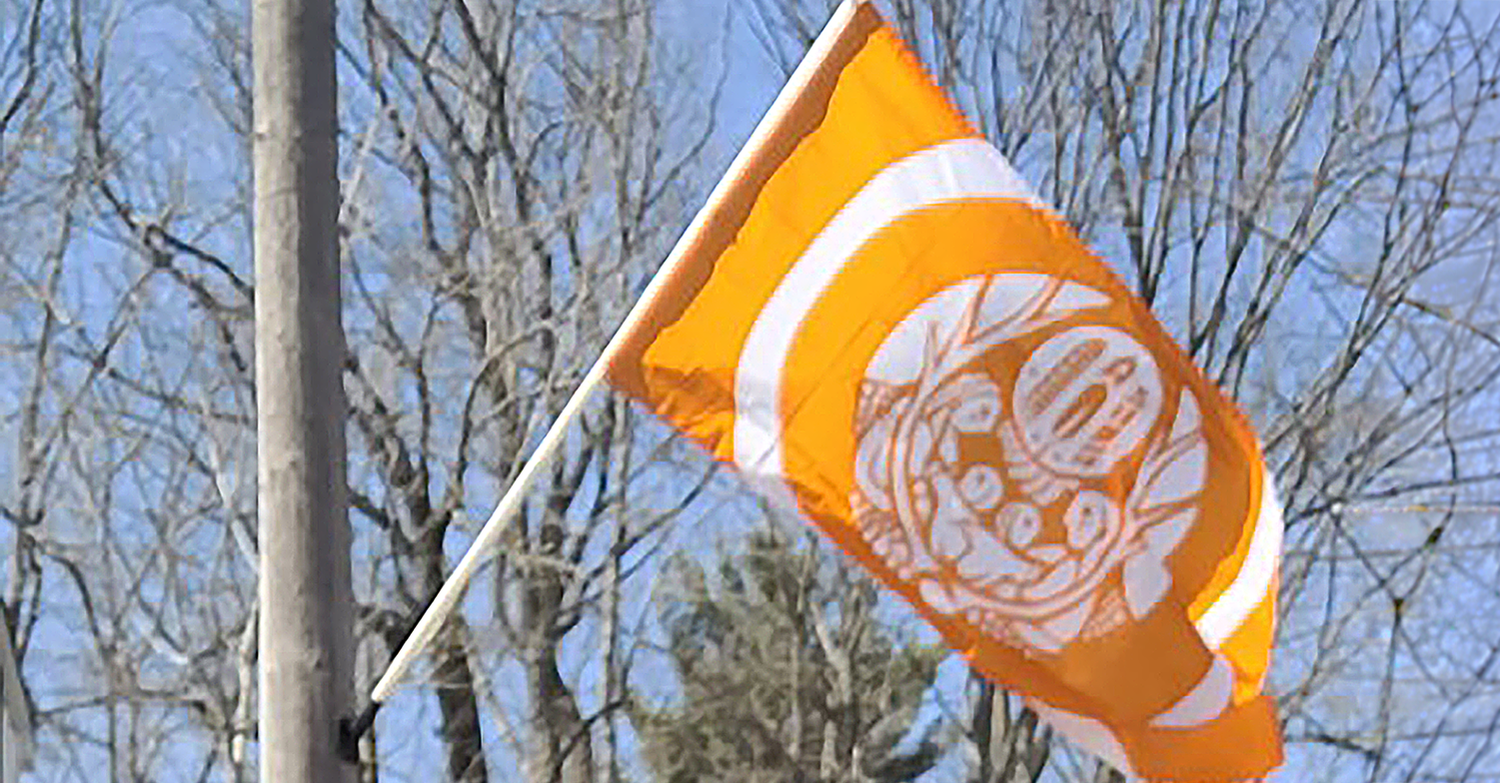
When the Anglican Church of Canada, Bishop Todd and the Primate requested that all churches fly a Survivors Flag I decided to purchase one for St. Anne’s as a gift. I chose an indoor flag as St. Anne’s did not have an outdoor flagpole. I also purchased a flagpole. Holy Trinity gave me a base for the flagpole that they were no longer using. A talented chap who helps me out took the base, cleaned it up and ‘sparkled’ it. I arrived at St. Anne’s with the flag, pole and base as they were preparing to host a spaghetti dinner. They dropped what they were doing to set up the flag and flagpole in the hall for all their guests to see.
Several weeks later, at a St. Anne’s Town Hall meeting, they said that they were going to purchase a second one, to display it outside. Lacking a proper flagpole the decision had been made to install the flag high up on a hydro pole at the corner of the church. This would keep it safe from trophy hunters, living in a resort area flags of interest have a short shelf life if they are easily accessible.
The Survivors’ flag does not have any words written on it; it has ‘elements’. They are: The Family, The Children, The Seeds Below Ground, Tree of Peace, Cedar Branch and Cosmic Symbolism, The Metis Sash, The Eagle Feather and the Inuksuit. You can see them on the accompanying photo.
In closing I would suggest that these two colourful flags are indeed prayer flags. It is St. Anne’s prayer that all who either drive by or enter know that they support Residential School Survivors praying for reconciliation and an end to generational trauma.
Rev. Stephanie Donaldson is an AFP Executive.