Interested, inquisitive, inspired and inspirational

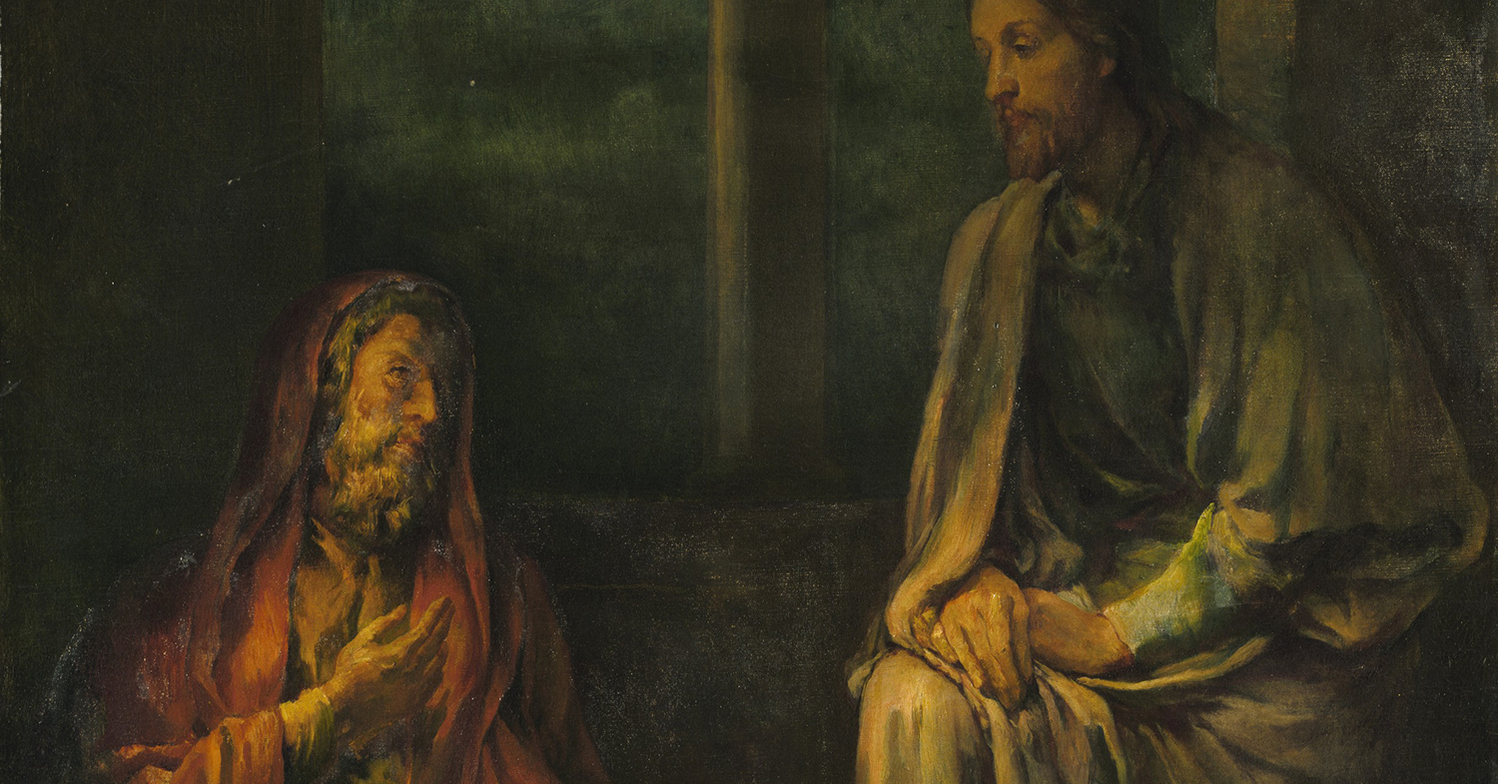
John La Farge, Visit of Nicodemus to Christ (detail), 1880, oil on canvas, 42 1⁄4 x 35 1⁄8 in. (107.2 x 89.1 cm), Smithsonian American Art Museum, Gift of William T. Evans, 1909.7.37
A VIEW FROM THE BACK PEW
By Rev. Canon Christopher B. J. Pratt
THROUGHOUT his earthly ministry Jesus has many life transforming encounters with people whose needs are obvious as they seek healing for themselves or for others. Jesus places himself into situations where his words challenge the powerful and shake the expected institutional and religious norms of his day.
Time and time again, I have been drawn back to a moment when Jesus meets a person whose connection with him seems to reflect the experience of many people who I have met during my years of ministry.
As a person who, from all outward appearances is an individual who has it all, Nicodemus approaches Jesus at night, away from prying eyes and curious crowds. He is aware of Jesus as a person who, as an individual and whose teaching has attracted the attention of many people. He has an interest in Jesus. He wants to know more about who he is and what he has to say.
Nicodemus is a person who has questions. When hearing Jesus speak of the need to be born again, Nicodemus, like many of us, simply asks, ”How can these things be?” (St John 3:9)
His words are not shaped in an engagement of a debate, but rather as a desire for clarity and in search of a deeper understanding of the message that Jesus is offering. Nicodemus is engaged in his own spiritual pilgrimage of faith as he seeks to grow in his own relationship with God.
As a pharisee and ruler of the Jews, he knows the Law. He has lived his life following the Law. He has taught others and seeks to ensure that others follow the Law. Still, he is an inquisitive person who wants to know more.
The encounter with Jesus gives Nicodemus much to ponder. After becoming part of the Gospel story with his interest and his questions we do not meet him again until we listen to the Pharisees engage in a conversation about what to do with Jesus, this person who they regard to be a charismatic renegade prophet, whose words and whose actions are attracting crowds and disrupting the accepted religious, political social norms of the day. In that setting, Nicodemus boldly asks the question, “Our Tribal Law does not permit us to decide against a man without giving him a chance to stand before the council and give an answer for what he does.” (St John 7:51)
In the 1600s, the little town of Oberammergau made a vow to tell the story of the Passion of Jesus if their community could be divinely spared being devastated by the bubonic plague. Every ten years, townsfolk ensure that the vow made centuries ago is upheld. Thousands of people crowd the outdoor stage waving palm branches, shouting “Hosanna”. Later, as the story unfolds, another large crowd gathers to shout, ”Crucify him!”.
As I sat in the audience in 2000 and again in 2010, I was moved by that moment when Joseph of Arimathaea was joined by Nicodemus as they lifted the body of Jesus from the Cross and placed his body in a garden tomb. In that dramatic setting, seeing members of the community lift and carry the body of another member of the community, bearing his full weight, took the story from off the pages of Scripture and gave them a realism which is indelibly etched in my mind. At that moment, I was struck by the inspirational presence of Nicodemus and his role and place in the Gospel story.
In the midst of the experience of Easter when people have the opportunity to stock up on eggs and chocolate there may also be some interest or, at least, curiosity, which will lead them to ask questions about the story undergirding this moment. This creates an opportunity for people of faith to fulfill our Baptismal Covenantal commitment to “…proclaim by word and example the Good News of God in Christ.”
Easter provides an opportunity to recognize that a spiritual journey that leads to the Cross and to the Empty Tomb starts with an interest in the story, followed by questions. Those questions offer a moment where answers may provide inspiration. That inspiration or the indwelling of the Holy Spirit, may very well lead to actions, which in their own way are inspirational.
It is my hope and prayer that this Easter Season you will be able to see in Nicodemus a person and a role model whose search led him to be one who, in his own way, discovered an opportunity in which he could serve Jesus.
May that be true in your life and mine.
Alleluia! Christ is Risen. The Lord is risen indeed. Alleluia!
Rev. Canon Christopher B. J. Pratt has retired from full-time parish ministry but continues to offer priestly ministry in the Diocese.
(The Gospel of St. John is referenced from “Walking the Good Road”, the First Nations Version - The Gospels and Acts with Ephesians.
Special Note:
Tickets are available online now for the 2030 Oberammergau Passion Play.)