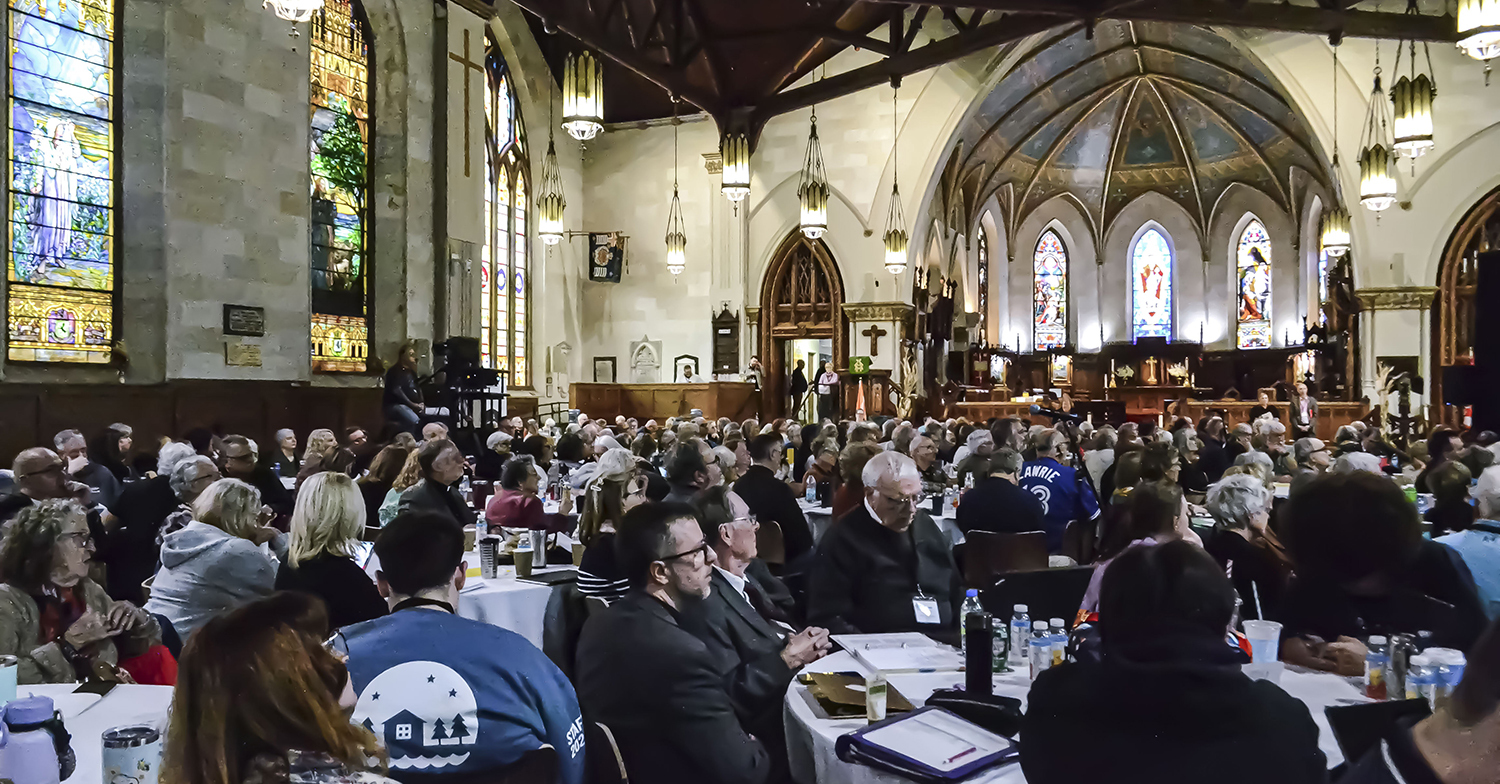
"Sharing stories that illustrate what is important to us and what should be important to yourselves." Photo: Rebekah Lemon
By Rev. Hana Scorrar
WE HAVE OFTEN in the church argued over what is the most important sacrament that we offer people. What is the entry into Christian life – Eucharist or Baptism? And I think for us the answer is neither, for a few reasons.
I will share with you a couple stories that illustrate why this is so important to us and why it should be important to yourselves as well.
When I first started volunteering in seminary at Zion, we – Ros and I – were doing Vacation Bible School and we had this young man who kept going into the sanctuary and he would always want to go over to the baptismal font. I finally followed him in one day and I asked him if he wanted to know a little bit about what was going on here.
He asked me, "Do I need to get baptized?" And I said, 'Well, why would you ask me that? Do you want to be baptized?”. And he said to me, “I think I need to be baptized because I'm native.” And I said, “Tell me a little bit more about what you're saying here.”
“Well, isn't that what baptism is for? So that you can be washed clean? And if I'm native, then I need to be washed clean from that. I need to find a way to not be native anymore. Being baptized will make me more like the church.”
I have had people come to my door at the church scared to come in because the last time they were at a church they were told they were not welcome because of the way that they were dressed, because of the tattoos on their arms, because of their hair color. They weren't welcome at the Lord's table because they weren't good enough for a Eucharist the way that they were coming to us.
So when we talk about the kind of healing that we do, the sacramental healing that we do, what we're really talking about is the one sacrament that we can offer to people that does not have a barrier of whether or not you have a sponsor, or whether or not the person that you love is an appropriate person to marry, or whether or not you've been baptized, or whether or not you participate in our communities. The one true sacrament that we can offer everyone that walks through our door is confession. and absolution. We can offer them healing. And it's something that doesn't require a fancy chalice and paten. It doesn't require a baptismal font. It doesn't require anything but a listening ear and an open heart.
I have taken confession in a taco restaurant from someone who told me if they don't confess, they're going to go home and kill themselves. I have done it walking in the woods. I did it a couple of weeks ago in the CAA tow truck that came to pick me up when my battery died. It is the thing that we can offer the world in a way that is beyond any words or rituals that we can offer. It gets really down to the heart of who we are as people and who we are as Christians. The ability to look at another person in pain and offer love compassion, grace, maybe a glimpse of hope.
When Jesus healed, he used the things of creation. He used mud, he used touch, he used breath, he used words. His healing actions were not magic but communion, God's love made tangible in the materials of the world. And indigenous peoples have always known this truth that the land itself is an altar. It is a table that is open and the medicines are its sacraments.
So, when we talk about healing, we are not just talking about a therapeutic gospel that is helping folks make peace with an inequitable world. We are talking about a disruptive, liberative gospel that is helping them heal broken hearts; that is helping them give voice to the unfairness and injustice of their world; that is helping them find a way to live and thrive even when living and thriving does not seem possible.
A lot of these stories are quite emotional. They weigh very heavily on both of us at times, but we offer them to you because we know that there are probably a lot of people that you have talked to in the same way. I'm sure that if you asked any person in here with a collar, they would tell you some of these same stories that they have dealt with. And I think we underestimate the importance of what we do when we offer those prayers. Even just the silence of holding somebody.
We like to think the work that we do needs stools and choirs and bells and smells. The work that we're doing every single day, giving people a reason to hope, giving people a reason to keep going, that is the work of this church and it's our most important duty.
Rev. Hana Scorrar is Indigenous Ministries Missioner in the Diocese of Huron.
Edited and adapted for print from a video presentation available on the diocesan website.
Source: https://www.diohuron.org/podcasts/media/2025-10-15-186th-synod-of-the-diocese-of-huron