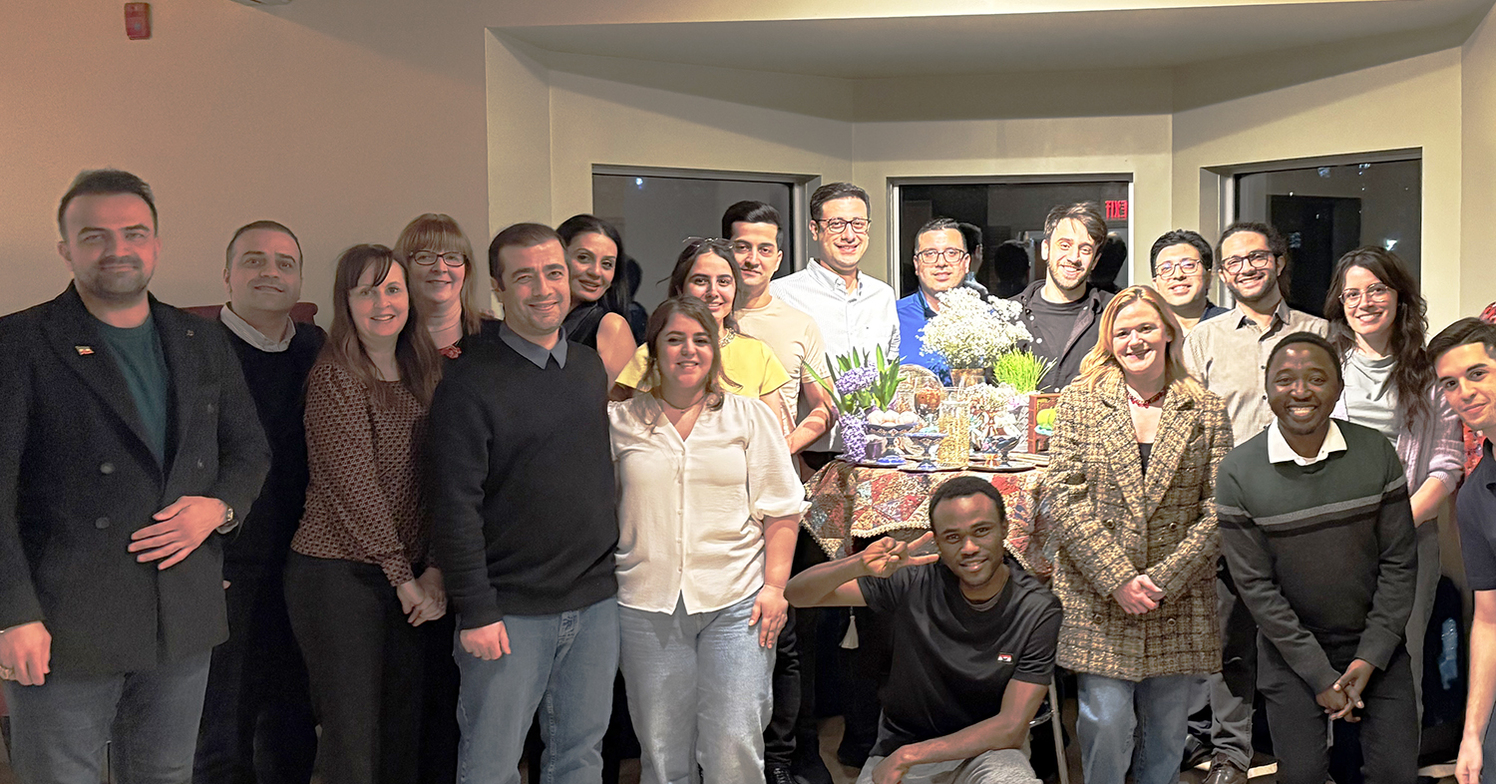
Students from Canterbury College gathered on March 20 to celebrate "Nowruz",
the Persian New Year.
By Ven. Carrie Irwin and Cynthia Connell
Canterbury College in Windsor is, at its heart, home away from home for many international students. It is a place of learning, conversation, and community.
Situated near the campus of the University of Windsor, it gathers students from across Canada and around the world into classrooms, common spaces, and student housing. It is a place where theology meets lived experience, and a place where questions are welcomed, faith is examined, and community is nurtured. But increasingly, it is also a place where global sorrow walks quietly through the door.
Many of the students who come to study here carry more than books and laptops. They carry the weight of two worlds. They sit in lectures and seminars while news alerts flash across their phones. They write papers while wondering whether their families are safe. They participate in chapel prayers while holding back tears for parents, siblings, and friends who live under threat, instability, or violence.
Recently, after a student shared her fear and anguish for loved ones in Iran, our community paused. We listened. We wept. And we prayed.
The prayer that accompanies this article emerged not from abstraction, but from presence, from the sacred act of sitting beside someone whose heart is breaking while being thousands of kilometres away from home. In that moment, Canterbury College becomes more than an academic institution. It becomes sanctuary. This is a sacred part of our vocation.
A college rooted in Christian tradition does not confine itself to intellectual formation alone. Theology must be spacious enough to hold real tears. Spiritual formation must make room for anger, helplessness, and lament. If we speak of a God who entered history in vulnerability and stood with the oppressed, then our classrooms and chapels must reflect that same solidarity.
For international students in particular, the experience of studying abroad is layered. There is the excitement of new friendships and new ideas. There is the challenge of cultural adjustment. And then, sometimes, there is the unrelenting anxiety of watching one’s homeland unravel from afar.
In these moments, Canterbury College seeks to be a place where no one suffers alone.
We gather in prayer not because prayer removes danger overnight, but because prayer binds us together. It reminds students that their stories matter here. That their families’ lives matter here. That their grief is not inconvenient to our schedules. That the Canterbury community’s concern extends beyond borders and political categories to the sacred dignity of every human life.
The prayer for Iran reflects this wider vision. It dares to ask God not only to comfort the suffering but to interrupt cruelty, to soften hardened hearts, to awaken conscience. It refuses to accept that terror has the final word. And it asks something more of us as well: that we remain open, compassionate, and courageous in the face of suffering we cannot fix.
This is what Canterbury College, within higher education circles, can uniquely offer in an anxious world, not simple answers, but faithful presence.
At Canterbury College, we are learning that formation today means helping students hold complexity: to love their homeland while building new community here; to wrestle with anger without surrendering to hatred; to pray for justice while trusting in mercy. It means creating spaces where lament is not weakness but faithfulness, where global pain is acknowledged rather than ignored.
When a student weeps for Iran, or Ukraine, or Gaza, or any place where fear grips daily life, we are called to widen our hearts. The work of theology in practice becomes deeply human. The Gospel becomes embodied in listening, in solidarity, in prayer. One way we are supporting the students in the Deanery of Essex is to open not only our hearts, but also our doors, welcoming students to come and share their experiences, their stories and their grief. Our hope is to walk alongside these storytellers in safe spaces for their witness, and our learning.
We cannot control events unfolding across oceans. But we can choose how we respond. We can choose to be present. We can choose to pray. We can choose to shape a community where no one has to carry the weight of two worlds alone.
And in doing so, we trust that the God who is present in every trembling prayer is also present in our classrooms, our chapels, and our shared tables, forming us, together, into people whose love is stronger than fear.
This is an invitation to every community to welcome those who have a story to share, a grief that needs compassionate and safe places to be told, and to open your hearts and doors as a place of refuge, where their stories and tears are honoured and their prayers mingle with your prayers.
A PRAYER FOR IRAN AND ALL WHO SUFFER UNDER TERROR
HOLY AND MERCIFUL GOD,
We come to you with hearts that ache and tremble for the people of Iran, for all who live under the crushing weight of fear, silence, and violence.
Where grief sits heavy in homes and hearts, be present. Where mothers wait for children who do not return, be present. Where brave voices are stilled by threat and force, be present. Where doubt and fears are given voice, be present. Not as a distant witness, but as the God who knows suffering so intimately. The God who weeps; who was born into danger, who stands with the oppressed and refuses to abandon us to despair.
We bring before you those who mourn, those who are imprisoned, those who hide their hopes in whispers, those whose courage costs them everything. Let them know they are not alone. Let your Spirit breathe strength where terror tries to rule and let love be deeper than fear.
And, O God, we also dare to place into your hands the hearts and hands of those who bring terror, those who command cruelty, those who carry it out, those who have forgotten the sacredness of every human life. Break open whatever has hardened them. Interrupt the stories of fear and power that bind them. Turn them toward conscience, compassion, and restraint, so that even now, the seeds of repentance and mercy might begin to grow.
God of all who suffer, we ask not only where you are, but ask you to strengthen our trust that you are here, present in every trembling prayer, present in every act of quiet courage, present in every heart that refuses to accept that violence should have the final word.
Hear our prayers for Iran, not as words sent into empty space, but as cries received within your boundless mercy, gathered into the deep compassion of your heart. Shape us, through these prayers, to become more open to your truth and your healing, that your grace may soften what is cruel, your Spirit strengthen what is fragile, and your holy light awaken what has gone numb.
Hold us, too, O God, in our anger, our helplessness, and our sorrow. Keep our hearts open, so we do not turn away from suffering, but remain fierce in love and faithful in hope. May justice rise. May fear loosen its grip. May peace, fragile yet persistent, begin to grow.
We place the people of Iran, their sorrow, their courage, and even those who oppress them into your wide and merciful care, trusting that your love is stronger than terror and your presence deeper than despair. Amen.
Cynthia Connell, Chaplain and Lay Pastor Canterbury College.
The Ven Carrie Irwin, Archdeacon of Southern Huron.