A church built of what they had

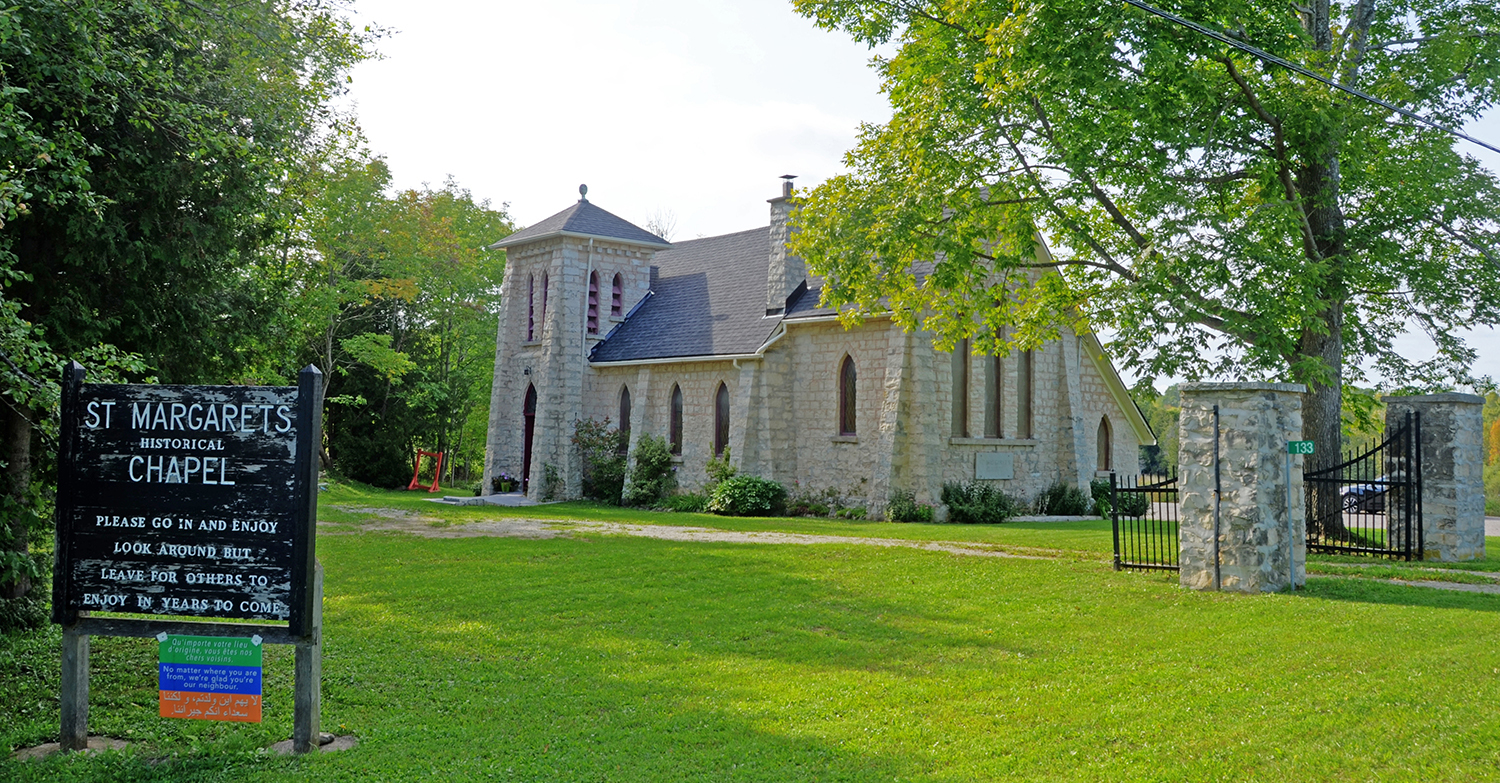
St. Margaret's Chapel at Cape Chin on the Bruce Peninsula was built in the 1920s. How did a small congregation manage to do it? Today, we might recognize their response as an early example of what has come to be called Asset Based Community Development.
By Rev. Kevin Dixon
THERE ARE many stories scattered across the Diocese of Huron about the building of our churches. They are stories of faith, certainly, but also stories of stewardship: people seeing what God placed in their hands and asking, What can we do with this?
One of the best comes from St. Margaret’s Chapel at Cape Chin, north of Lion’s Head on the Bruce Peninsula.
The story is preserved in W. Sherwood Fox’s The Bruce Beckons: The Story of Lake Huron’s Great Peninsula, published in 1952. Fox knew Canon R. W. James – the legendary Anglican priest affectionately known throughout the Bruce as “Daddy James” – and drew upon James’s own recollections.
In the early years, Anglicans around Cape Chin had no church of their own. They worshipped in McCallum’s schoolhouse. It served its purpose, but the congregation longed for a place set apart for worship.
Eventually, Daddy James took their hopes to an architect and fellow churchman. His vision was specific. The church should be built of stone – the limestone of the Peninsula itself. It should stand on a rise of land. And although it would be a little church in a remote corner of the Bruce Peninsula, there was no reason it should not reflect the beauty of the Anglican tradition, right down to its lancet windows.
A plan was drawn. Then came the harder question: How could a small rural congregation possibly build it?
Today, we might recognize their response as an early example of what has come to be called Asset Based Community Development, or ABCD.
ABCD begins with a deceptively simple principle. This principle stands against the idea that we should begin by making a list of everything a community lacks: money, facilities, expertise, people. Instead, we can begin by identifying the gifts and assets already present. What skills do people have? What relationships exist? What physical resources are available? What might become possible if those gifts are brought together?
Instead of beginning with scarcity, ABCD asks, What do we have? This is an abundance mindset.
This is also an important stewardship question. The congregation at Cape Chin could easily have begun with scarcity. They did not have a large congregation, abundant financial resources or all the equipment needed for a significant building project. But they had some things: local stone, trees for lumber, horses and teams, farmers and tradespeople and neighbours, strong backs and willing hands, and relationships beyond their own congregation.
They also had a determined priest with a Model T Ford which, in due course, became relevant to the story.
Daddy James took the building plan to his parishioners and essentially asked: Here is what it will cost in money and labour. What will you do? Their answer became a stewardship testimony written in stone.
Local families supplied teams and labour to haul stone. Men broke the large blocks with hammers into pieces suitable for the walls. Two professional masons laid the stone, but much of the work was done by volunteers. Daddy James himself swung a nine-pound sledgehammer alongside his parishioners and hauled stone behind his Ford.
Then there was the lumber. Some of the trees needed for the joists, rafters, beams and boards were growing near the church. The congregation had trees, willing hands and Daddy James’s Model T. What they did not have was a sawmill. So, they made one.
They backed the rector’s Ford into a clearing, blocked the front wheels and jacked the rear wheels off the ground. They rigged a belt to transfer power from the spinning rear wheels to a saw, and so the automobile became the parish sawmill.
As the walls rose, enthusiasm spread beyond the congregation. People of other Christian traditions helped. Passing visitors contributed. A group of fishermen visiting the Peninsula heard Daddy James tell the story of the little church and made donations.
That gave birth to one of the more entertaining legends of the Bruce Peninsula.
The story began circulating that the fishermen’s contribution was actually the proceeds of a poker game. Fox, who knew the people and circumstances, was emphatic that the story was not true. But good stories have a way of travelling, and this one did.
Remarkably, the legend itself generated generosity. When the tale reached the fishermen’s home city, the head of a large glass company offered to provide the glass for the church windows. A wealthy widow offered the seating.
Construction had begun in 1925. The cornerstone was laid the following year. By 1927 the building was under roof. And when St. Margaret’s was dedicated by the Bishop of Huron in 1928, worshippers sat in solid oak pews while sunlight streamed through coloured glass in those lancet windows Daddy James had insisted upon.
There is something wonderfully biblical about this story, because at its heart is one of the most important changes of mindset that is core to holistic Christian stewardship: the movement from scarcity to abundance.
Scarcity asks, How can we possibly do this when we have so little? Abundance asks, What has God already placed among us?
An abundance mindset does not pretend resources are unlimited or genuine needs do not exist. The people of Cape Chin really did lack money, equipment and other resources. But they refused to allow what they lacked to define what was possible. Instead, they began by noticing what they had.
This is precisely where holistic stewardship begins. Christian stewardship rests upon the conviction that creation itself is a gift, our abilities are gifts, our relationships are gifts, and God has entrusted resources to individuals and communities that can be shared and multiplied. Gratitude teaches us to notice these gifts. Generosity puts them into circulation.
This is why the story of St. Margaret’s is more than an interesting episode from the history of the Diocese of Huron. It is a stewardship testimony with something to say to our churches today.
When faced with a challenge, our first instinct can be to inventory our deficiencies: We don't have enough money. We don't have enough volunteers. We don't have enough young people. We don't have the resources we once had.
Asset Based Community Development invites us to begin somewhere else. Who is here? What gifts has God given them? What resources are already among us? What relationships could be strengthened? What could we do together that none of us could do alone?
The people who built St. Margaret’s did not begin with everything they needed. They began with what they had. Nearly a century later, St. Margaret’s still stands at Cape Chin. It is a beautiful little church. But perhaps its greatest beauty is the stewardship testimony embodied in its walls: when God's people stop beginning with what they lack and begin instead with what God has already provided, scarcity can give way to abundance, gratitude can become generosity, and generosity can build something none of us could build alone.
The stones themselves bear witness.
Rev. Kevin Dixon is Diocesan Stewardship Coordinator.